Is Your AI Quietly Building You a Time Bomb?
12 June 2026
/24 mins read
AI
Software Development
Developer
Hey everyone 👋 Hope you’re all doing well?
The other day I was scrolling through my feed, looking at all the cool stuff people have been shipping with AI, and a thought hit me…
These days — ever since we got Generative AI, Transformer models, LLMs, AI that’s smart, cheap, easy to reach, and simple enough for anyone to pick up —
everyone’s building their own things. And honestly, that’s amazing. The fact that any of us can just build now is wonderful… but have you actually thought about what happens after you ship it?
I’d bet 70–90% of software developers already know everything I’m about to say. I’m writing this for the folks who maybe haven’t stopped to think about it yet.
This post won’t cover everything about looking after a product once it’s built — it’s just one piece. But it’s an important one, especially if you’re not used to software development.
Who’s this for?
- Anyone building their own product, whether you’re leaning on AI or not.
So… what time bomb?
From the title, you’re probably wondering — what “time bomb”?
When we build a product or a system, it’s made of a lot of moving parts. It’s stitched together from many sets of code — hundreds of thousands, sometimes millions of lines. Each piece does its own specific job, handles its own feature.
If we compare building software to building a house, it’s like a place with a ton of rooms. Each room is packed with materials and parts — beams, bricks, steel wire. Those are like each set of code.
And sure, these days we don’t write all of that by hand. We just let the AI build the whole thing for us. No time wasted, just build the whole damn thing, boom.
Bricks, grout, logic, wallpaper, styling, pretty buttons, this and that — nah, don’t worry, my dear AI will make it for me! It can do it all, rewrite it from line one, all mine.
But here’s the catch… that might just be your “build-it-yourself time bomb.”
The build-it-yourself time bomb
In the real world, when we ship a product, we expect it to keep running. Don’t break, no problems, don’t get hacked, don’t lose data, don’t get robbed, just keep working.
Early on, you probably won’t hit anything. But give it time. Your code gets old. The code your AI wrote might not play nice with the systems of that day anymore. It might not have covered some edge case, and a gap opens up — one a hacker can crawl through to take your stuff, your money, or just break the whole thing. Or maybe your code simply doesn’t run efficiently. Or any number of nasty surprises you never saw coming.
And most of this, you can’t fully guard against. Sometimes it isn’t even your fault — it could be your machine, the language you picked, anything!
So what now? If you let AI write everything, or you write everything yourself, the real question is: can you actually review every single inch of that code? Can your AI keep track of all of it? Are you genuinely willing to drop tens — or hundreds — of thousands to fix these problems later?
So why not use what someone else already built? Something that’s maintained, already optimized, with clear rules and structure, and real people looking after it. Why do we have to build the entire thing ourselves with AI?
You don’t have to build everything yourself
There’s a saying you’ve probably heard: “Don’t Reinvent the Wheel.” Don’t rebuild something that already exists, because it might not even be worth the effort to build from scratch.
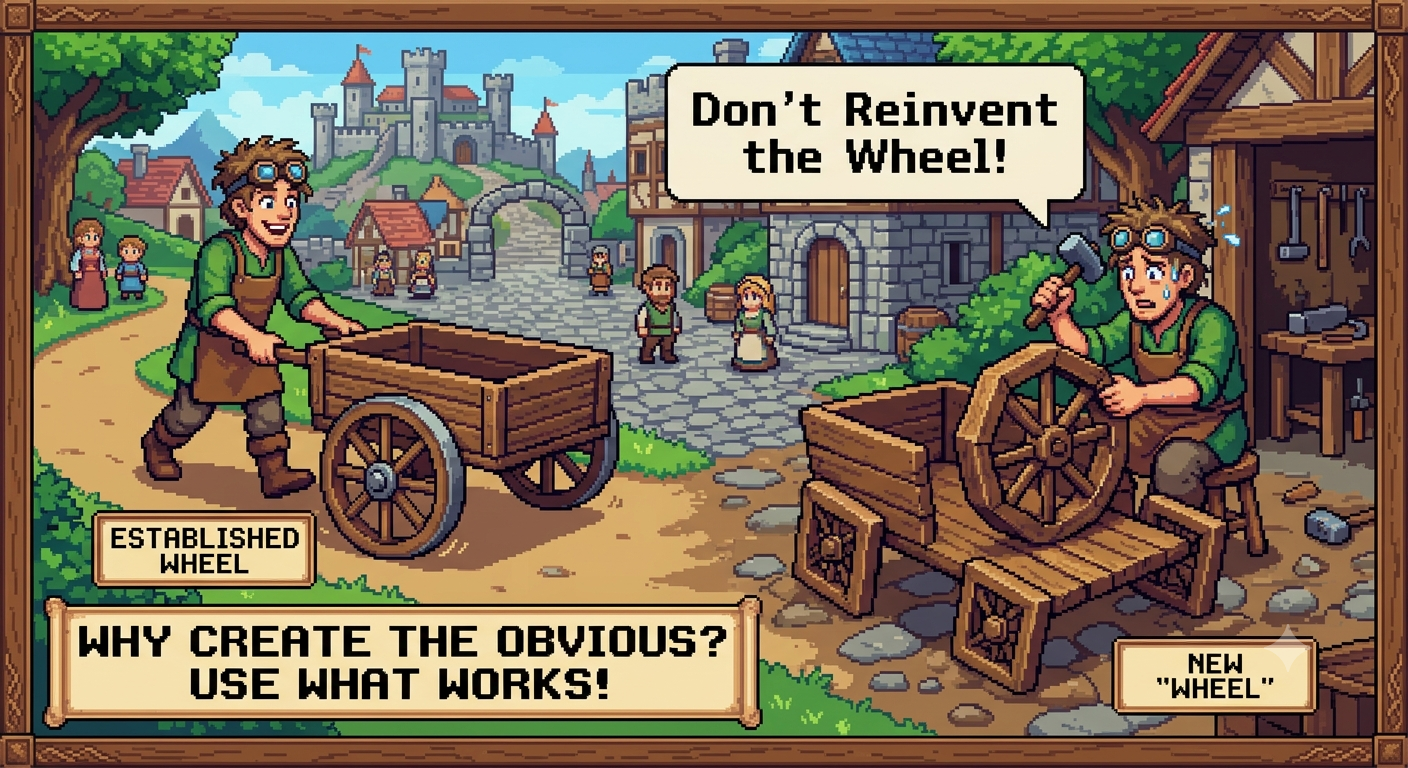
Building everything yourself has a price. The time you burn tracing and checking. The specialized knowledge you have to pick up just to fix things. The money to hire an AI — or a human — to patch it up… or even to pay a fine.
It’s the same as your house — you don’t need to build every single thing in it from scratch. You can buy materials and furniture that already exist, already made, that meet a standard and come with after-sales support.
So sometimes a product — or just part of one — doesn’t need to be built by you. Borrowing, or using someone else’s work, might honestly be the better call.
Why using someone else’s work is a good thing
Let me give you two quick examples to paint the picture.
Save tokens, save money, save my a**
Pretty obvious one. Instead of having the AI write a giant chunk of code to handle one part, we just call something someone else already made — and that saves a ton of tokens, time, and AI horsepower.
Reasonably safe, and easy to keep using
Back to the household stuff. Say you built a TV yourself, at home, entirely on your own, with maybe not much electronics knowledge. Where would you even source the parts? How do you build it without starting a fire? How do you get a sharp picture without the cost spiraling out of control?
But if we use a TV from an actual manufacturer — one that’s supported and built to serve loads of buyers — we can be confident that if it breaks, there’s service behind it. We can send it in for repair, the TV turns on, we get to watch our movies, and most technicians already know how to fix it.
Same deal with software. If we use something someone else already built, with experts behind it and a real user base, we can (probably) trust that someone’s going to keep maintaining it. And if we ever need someone else to pick up our product later, other people — or AI — will get it easily and carry on almost right away.
The downsides of using someone else’s work
Of course, when you go eat a bowl of noodles someone else cooked, sometimes it’s just never quite as good as cooking and seasoning it yourself.
It’s not as flexible as building your own
Sometimes you’ve got really specific needs that someone else’s work just can’t cover — or that take so much tweaking to fit that it stops being worth it.
And sometimes it isn’t worth customizing it yourself, or you end up having to build it from scratch anyway. Compared to that, finding a workaround to make it fit might still be the better option.
Wrapping up
Building everything from scratch with AI can be exciting and genuinely fun. But you’ve got to keep an eye on that “time bomb” that might go off down the road. Using something someone else already built is a solid choice — it saves time, saves money, and buys you a bit more safety. You just have to accept the limitations that come with it.
In the end, I want to leave you with one thing to chew on: should we let AI build everything from scratch, or should we lean on what others have already made — so we can actually maintain and grow our product sustainably over time?
That’s all from me for today — I’m going to roll out before I accidentally reinvent another wheel. 🛞 Catch you in the next one!
by Jirachai C.